
Kentucky Shark Week 2026 - Before the Bluegrass, There Were Sharks
Though not common, many kinds of ancient shark and shark-relative teeth can be found in Kentucky in Mississippian and Pennsylvanian strata.
Some ancient sharks and shark relatives had teeth that were shaped like thick fingernails, tiny arching bars, or small irregular shapes that most people would not recognize as teeth, let alone the teeth of something like a shark. More than just having a tooth-like shape, fossil teeth have textural details which allow them to be identified as teeth. Fossil shark and shark-related teeth tend to have:
(1) A crown which looks polished relative to surrounding matrix rock
(2) External punctate texture (described below) in the crown
(3) A distinct crown overlying a root or root-like base (in many cases)
(4) Vascular (spongy bone) texture in the root or root-like base
(5) Internal vascular (spongy bone) texture (dentin) within the crown (if exposed on the margin)
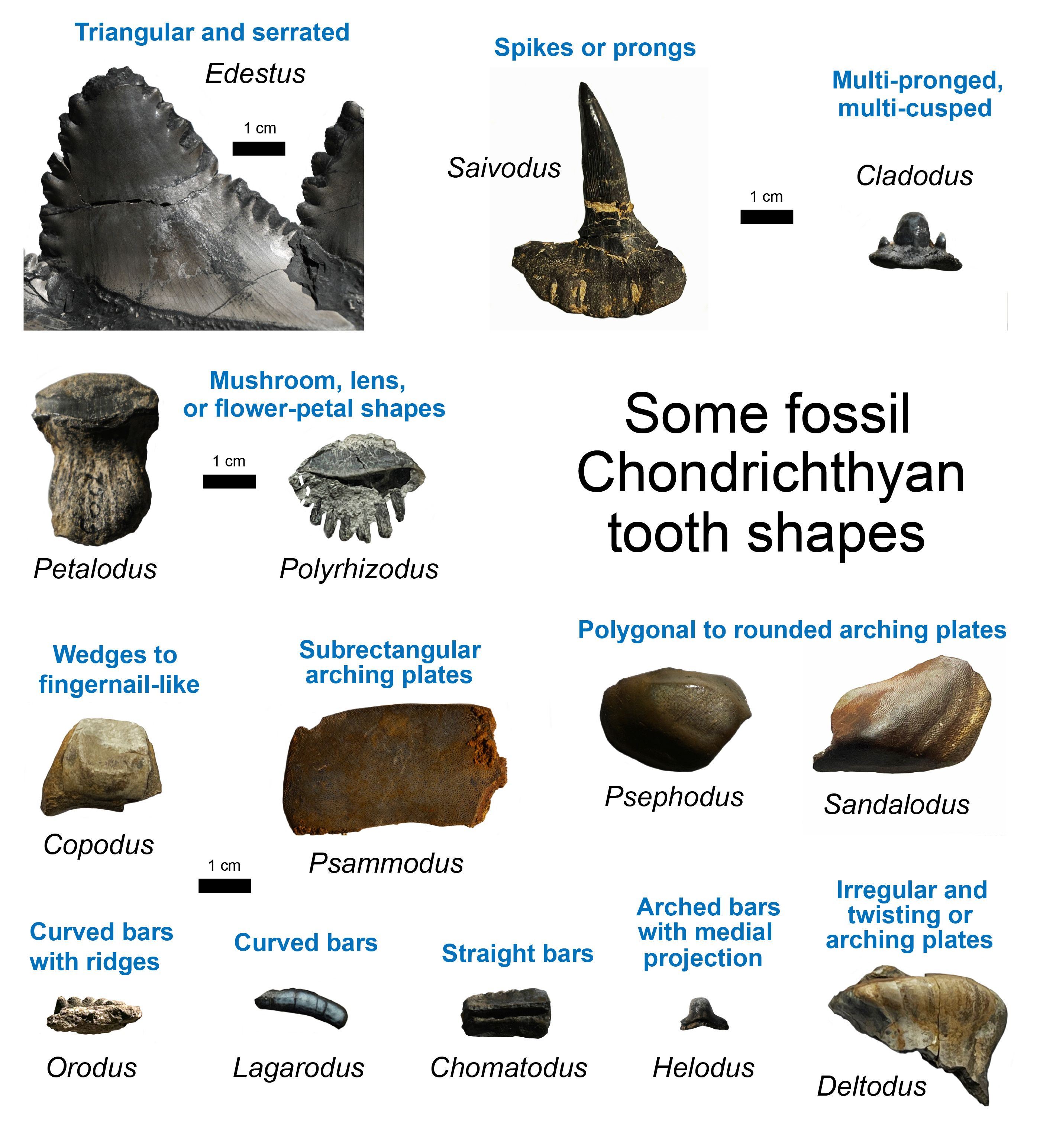
Fossil ancient shark (elasmobranch) and shark-like (holocephalan) teeth have a variety of shapes that served a variety of functions based on comparisons with the shapes of modern shark and ray teeth. Tooth shapes with sharp edges are better for slicing, while shapes that are pointed are better at puncturing or stabbing. Some tooth shapes are broadly rounded or flattened and are better for crushing or grinding. Some have a combination of functions.
Here are some of the types (genera) that can be found in Carboniferous (Mississippian, Pennsylvanian) rocks in Kentucky. Some shapes are easily recognizable as teeth, while others are not. All have punctate or bony texture when examined up close. Black bars are one-centimeter scales.